
Elite Fireplace: Top Chimney Masonry Repair Services in Rancho Cordova, CA
Rancho Cordova, CA is a community built on active living, family values, and a deep appreciation for the outdoors. At Elite Fireplace, we believe your home should be a sanctuary that reflects those same values. A well-maintained fireplace and chimney are central to that feeling of comfort, yet the masonry that holds these structures together is often overlooked until significant damage appears. Our team specializes in high-quality chimney masonry repair, ensuring that the focal point of your living room remains structurally sound and visually appealing.
From repointing crumbling mortar joints to rebuilding storm-damaged stacks, we bring expert craftsmanship and a keen eye for detail to every project. We understand that California weather and geological conditions place unique stresses on masonry. Whether you own a mid-century home near the American River or a newer property in Sunridge Park, we treat your home with the same care and respect we would our own. Our goal is to extend the lifespan of your chimney while making it safer for you to enjoy.
Home »
What Early Warning Signs Show That a Leaning or Cracking Chimney Is At Risk Of Partial Collapse?
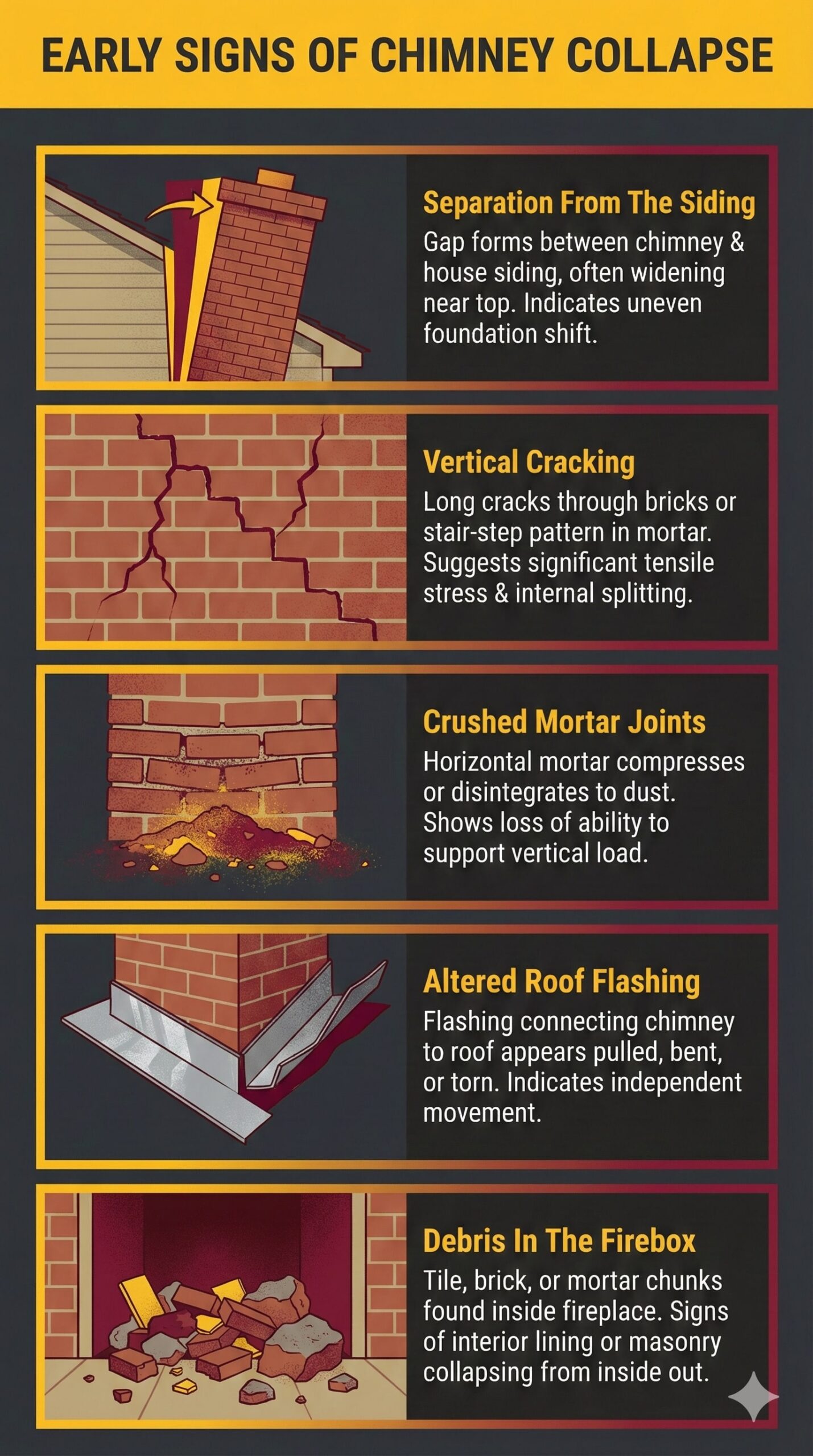
Identifying structural risks early is critical for preventing catastrophic damage to your roof or injury to those below. While a chimney might look sturdy from the ground, subtle shifts in its geometry or surface texture can indicate deep-seated instability. Here are the signs our technicians look for when assessing collapse risk:
- Separation From The Siding: If you notice a gap forming between the chimney structure and the exterior siding of your house, this is a primary indicator of a leaning chimney. This gap often widens near the top. It usually suggests the foundation of the chimney has shifted or settled unevenly compared to the home.
- Vertical Cracking: Long cracks running vertically through multiple bricks or following the stair-step pattern of the mortar joints suggest that the masonry is under significant tensile stress. These cracks often mean the internal structure is splitting apart.
- Crushed Mortar Joints: In some cases, the weight of the chimney compresses the mortar to the point of disintegration. If the horizontal joints look compressed or are turning to dust, the chimney is losing its ability to support its own vertical load.
- Altered Roof Flashing: If the metal flashing connecting the chimney to the roof appears pulled, bent, or torn, it indicates the chimney has moved independently of the house structure.
- Debris In The Firebox: Finding bits of tile, brick, or large chunks of mortar in your fireplace is often a sign that the interior lining or masonry is collapsing from the inside out.
If you spot these issues, it is vital to contact a professional immediately. We can install helical piers to stabilize foundations or perform partial rebuilds to correct the lean before gravity takes over.
Rancho Cordova, CA: A Vibrant Community We Are Proud To Serve
Rancho Cordova is more than just a suburb of Sacramento. It is a thriving city with a distinct identity and a wealth of recreational opportunities. We love working here because the residents take pride in their community and their homes. The city is perhaps best known for its access to the American River Parkway. This jewel of the region offers miles of cycling, running, and kayaking opportunities.
Residents here enjoy a unique blend of history and modern growth. We frequently service homes near the historic Mills Station and Mather Air Force Base. This area has transformed into a hub for commerce and recreation, including Mather Regional Park. The “Barrel District” creates a fun local culture with its breweries, distilleries, and mead halls. It fosters a strong sense of neighborhood connection. Whether families are spending the day at the Sacramento Children’s Museum or hiking the Jedediah Smith Memorial Trail, there is an active energy here that we admire. At Elite Fireplace, we aim to match that energy with responsive, high-quality service that keeps Rancho Cordova homes running as smoothly as possible.
Do Earthquakes or Seismic Tremors Loosen Mortar Joints Enough To Create Dangerous Flue Gaps?
Living in California means acknowledging the reality of seismic activity. While Rancho Cordova may not experience the frequency of tremors that coastal cities do, the entire region is subject to ground movement that can wreak havoc on rigid masonry structures. Bricks and mortar are strong under compression but have relatively low tensile strength. This means they struggle to hold together when shaken side-to-side.
- Micro-Fractures In Mortar: Even minor tremors can cause hairline fractures in the mortar joints. Over time, these micro-fractures weaken the bond between the bricks. While the chimney may not collapse, the structural integrity is compromised. This makes it more susceptible to wind damage or future seismic events.
- Severing The Flue Liner: One of the most critical risks involves the clay tile flue liners found in many older chimneys. Seismic shaking can crack these rigid tiles or cause them to misalign. When the liner cracks, it creates a direct path for heat, smoke, and carbon monoxide to transfer into the combustible framing of your home or seep into living areas.
- Dislodged Chimney Crowns: The shaking motion can break the bond of the concrete crown at the very top of the chimney. If the crown loosens, it allows water to pour directly into the masonry system. This accelerates decay exponentially.
- Hidden Fire Hazards: The most concerning aspect of seismic damage is that it is often invisible from the exterior. The bricks might look fine, but the internal mortar joints could have crumbled. This creates gaps that allow fire to escape the flue.
We recommend a Level II video inspection following any noticeable seismic event. This allows our team to send a camera down the flue to verify that the mortar joints and liners remain intact and that your system is safer to use for the coming season.
How Fast Can Crumbling Mortar Compromise a Chimney’s Stability? Could It Really Collapse in Just One Season?
Homeowners often view mortar deterioration as a purely cosmetic issue. They assume they have years to address it. However, once mortar begins to crumble significantly, the timeline for structural failure can accelerate much faster than anticipated. It can sometimes worsen dramatically over the course of a single wet season.
- The Sponge Effect: Mortar acts as a sealant between bricks. When it begins to crumble, it becomes more porous. It absorbs water like a sponge. Even in milder climates, trapped water adds immense weight to the structure. This added static load puts stress on the already weakened joints. It causes them to fail more rapidly.
- Washout: During heavy rains, water entering through the top of a compromised chimney can wash out the lime and sand from the mortar joints. We have seen instances where “sand runs” occur. This effectively hollows out the joints from the inside. This leaves the heavy bricks resting on nothing but gravity and friction.
- Wind Loading: A chimney with solid mortar acts as a monolithic column. A chimney with crumbling mortar acts as a stack of loose blocks. If a strong winter storm brings high winds, the lack of adhesion means the chimney has little resistance to lateral force. A chimney that was merely “needs repointing” in October could become “structurally unsound” by February if hit by the right combination of rain and wind.
- Thermal Stress And Drying: In our warmer climate, the rapid cycle of wetting followed by intense solar heating creates stress. Wet mortar that is suddenly baked by the sun can shrink and crack further. This creates larger gaps for the next rainstorm to exploit. The UV exposure degrades the binder in the mortar, turning it to dust faster than in shaded areas.
Our team uses specialized tuckpointing techniques to grind out the damaged mortar and replace it with a fresh, water-resistant compound. This restores the compressive strength of the chimney and stops water intrusion in its tracks.
Are Old, Unlined Chimneys More Prone to Hidden Interior Decay Even When the Exterior Bricks Look Strong?
It is a common misconception that if the outside of the chimney looks robust, the inside must be in similar condition. In reality, older, unlined chimneys are highly susceptible to a specific type of interior decay that remains hidden until it causes a major problem. These are common in historic homes or those built before the mid-20th century.
- Acidic Flue Gases: When wood burns, it produces combustion byproducts. These include water vapor, creosote, and various organic compounds. In an unlined chimney, these gases come into direct contact with the masonry. When the gases cool, they condense into an acidic residue. This residue eats away at the mortar joints from the inside out.
- Softening Of The Brick Faces: Over decades, this acidic attack can soften the interior face of the bricks. We often find that the inner inch of brickwork has turned to powder. This drastically reduces the thickness and insulation value of the chimney walls.
- Heat Transfer: Without a liner, heat from the fire transfers much faster through the masonry. This constant heating and cooling cycle causes thermal shock to the mortar. Since the interior heats up faster than the exterior, the differential expansion shears the bond between the brick and mortar.
- Liquefied Creosote Leaks: In unlined chimneys, creosote can seep deeply into the pores of the brick. In severe cases, we see black, tar-like substances leeching through to the exterior brickwork or interior plaster walls. This is not only unsightly but highly flammable and smells terrible.
- Carbon Monoxide Risks: As the interior mortar joints dissolve, they create pathways for carbon monoxide to enter the home’s envelope. Because the exterior bricks still look solid, homeowners often have no idea this gas leakage is occurring.
For unlined chimneys, we almost always recommend installing a stainless steel liner or a cast-in-place resurfacing system. This creates a new, durable barrier between the combustion gases and the original masonry. It helps preserve the structure and helps the system vent as efficiently as possible.
Does Rainwater Penetration Accelerate Deterioration in Mild Climates? How Can Waterproofing Slow It Down?
Many homeowners assume that masonry damage is only a concern in cold climates with snow. However, in regions like Rancho Cordova, rainwater penetration coupled with heat is actually a leading cause of masonry decay. Bricks are essentially hard sponges. Without protection, they wick up moisture which triggers a variety of destructive processes.
- Salt Migration (Subflorescence): As water moves through the brick, it dissolves natural salts found in the clay and mortar. When the sun hits the saturated brick, the water evaporates rapidly. This leaves the salts behind to crystallize just beneath the surface. The pressure from these expanding salt crystals pops the faces off the bricks. This is a common cause of spalling in warm climates.
- Biological Growth: Damp masonry is a breeding ground for biological growth. Moss and algae roots can penetrate the mortar. This creates tiny fissures that allow more water to enter. This biological layer also holds moisture against the chimney. It prevents it from drying out between storms.
- Rusting Of Metal Components: Water that penetrates the masonry eventually reaches metal components like the damper, smoke shelf, and flashing. This causes them to rust and expand. Rust expansion is powerful enough to crack the surrounding masonry. This necessitates expensive repairs.
- Binder Dissolution: Continuous saturation can leach the binding agents out of older lime-based mortars. This turns solid joints into sandy powder that blows away in the wind or washes out in the rain.
We apply a professional-grade, vapor-permeable water repellent to combat this. Unlike a sealant that traps moisture inside, our waterproofing agents allow the chimney to “breathe” out internal vapors. At the same time, they prevent exterior rain from entering. This simple preventive step can extend the life of your masonry work by decades, keeping your chimney drier and structurally sounder.
Trust Elite Fireplace for Masonry Repair in Rancho Cordova, CA
At Elite Fireplace, we combine old-world masonry skills with modern diagnostic tools to provide the best possible care for your home. Whether you are dealing with storm damage, seismic concerns, or simply the wear and tear of time, our team is ready to restore your chimney’s strength and beauty. We are proud to serve the Rancho Cordova community and help our neighbors keep their hearths warm and welcoming.
Don’t wait for a small crack to become a major structural failure. Contact Elite Fireplace today to schedule your comprehensive masonry inspection and repair.